
We ship all across the USA
SHOP NOW
Will Quick Fix Pass a Lab Test vs. a Cup Test? (2026 Guide)

Many people search: “Can Quick Fix pass a lab test?” or “Can Quick Fix pass a cup test?”


Synthetic urine products like Quick Fix are popular for navigating urine drug screenings, but outcomes depend heavily on the testing method, level of oversight, and how closely the product matches real human urine. This educational guide breaks down the key differences between rapid cup tests (instant/on-site) and lab-based drug tests, including how specimen validity testing (SVT), confirmation methods, and regulations affect results.

The Two Main Types of Urine Drug Tests.


Urine drug testing generally falls into two categories:

- Rapid cup tests (instant / point-of-care)
- Laboratory-based tests with confirmation
- Both analyze urine samples, but they differ significantly in technology, accuracy, and scrutiny.

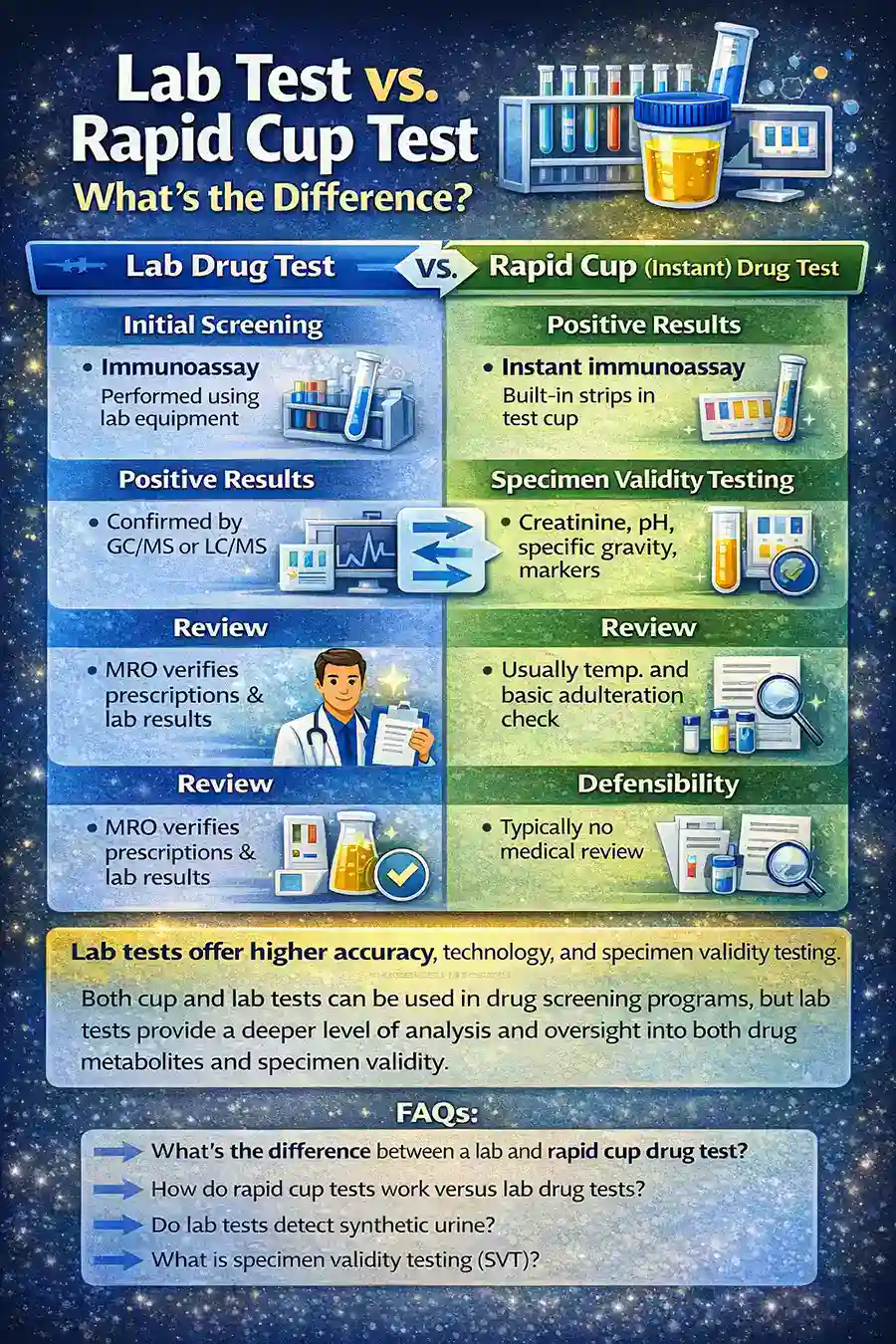
What Is a Rapid Cup Drug Test

A rapid cup drug test (also called an instant drug test or immunoassay cup) is conducted on-site. The donor provides a urine sample, and results appear within minutes using built-in test strips.

How It Works

- Temperature check (usually within 4 minutes of void)
- Built-in immunoassay strips detect drug classes
- Visual results appear quickly

Common Drugs Screened

- THC (marijuana)
- Cocaine
- Opiates
- Amphetamines
- Benzodiazepines
- PCP

Limitations of Rapid Cup Tests

Rapid cups are presumptive screening tools only. A non-negative result often triggers lab confirmation via GC/MS or LC/MS.

Most basic cups:

- Check temperature
- Sometimes include simple adulteration strips
- Do not perform deep specimen validity testing
- Related searches: instant drug test, point-of-care screening, rapid urine test, on-site drug testing

What Is a Laboratory Drug Test?

Laboratory drug tests send the urine specimen to a certified toxicology laboratory for multi-step analysis.

Laboratory Testing Process

Initial immunoassay screening Similar in concept to cup tests, but performed using calibrated lab equipment with strict quality controls.

Confirmation testing


Any non-negative screen is confirmed using:

- GC/MS (Gas Chromatography/Mass Spectrometry)
- LC/MS/MS (Liquid Chromatography/Tandem Mass Spectrometry)
- These are considered the gold standard in forensic toxicology and identify specific metabolites at precise cutoff levels.
- Laboratories excel at forensic-level accuracy and defensibility.

* Related searches: GC/MS confirmation, LC/MS drug testing, confirmatory testing, certified toxicology lab
* The Critical Difference: Specimen Validity Testing (SVT)
* One of the biggest differences between cup tests and lab tests is specimen validity testing (SVT).

Laboratories routinely evaluate:

- Creatinine levels
- Specific gravity
- pH balance
- Oxidizing agents
- Adulterants
- Synthetic markers (in advanced panels)

SVT determines whether a sample is diluted, adulterated, substituted, or otherwise invalid.

Rapid cups rarely match this depth. Most only verify temperature and basic adulteration indicators. This gap explains why synthetic products may perform differently in cup tests vs. lab tests.

Related searches: specimen validity testing, synthetic urine detection, urine adulteration detection, creatinine and specific gravity testing

Can Quick Fix Pass a Cup Test?


Many users report success with basic instant cup tests, especially when:

- Temperature is within range
- No advanced adulteration checks are present
- Because most cups rely on simple immunoassay screening, they may not detect more subtle specimen validity issues.

Can Quick Fix Pass a Lab Test?

Yes, Quick Fix can pass a lab test like one processed at Quest Diagnostics

Quick Fix (including newer versions such as 6.4) is designed to mimic key urine markers, including:

- Urea
- Uric acid
- Creatinine
- pH
- Specific gravity

* Many user reports claim successful outcomes at major labs (such as Quest or LabCorp) in unsupervised, non-DOT, pre-employment settings.

However, risks increase when testing involves:

- Advanced specimen validity testing
- Observed collections
- Proprietary detection methods
- Stricter regulatory oversight
- Across both testing types, temperature remains the most common failure point.

DOT vs. Non-DOT Drug Testing

DOT-regulated testing (trucking, aviation, rail, transit, maritime) follows strict federal rules under 49 CFR Part 40, including:

- Full chain of custody documentation
- Split specimen collection
- Mandatory lab confirmation
- Medical Review Officer (MRO) oversight
- Possible observed collections
- Non-DOT testing (private employers) is often less rigorous and varies by company policy.

Related searches:

DOT urine drug test, federally regulated testing, chain of custody, MRO review Why Lab Testing Is More Defensible Laboratory testing is designed to be scientifically and legally defensible, using: Strict calibration standards Blind proficiency testing Mass spectrometry confirmation Medical Review Officer oversight These safeguards make lab results more reliable for employment disputes, audits, or legal review. What Happens If a Sample Fails Validity Testing?

If specimen validity testing detects abnormalities, results may be reported as:

- Invalid
- Adulterated
- Substituted
- Rejected for testing

In regulated programs, this often triggers: Observed recollection Employer notification MRO review
Related searches: invalid drug test, adulterated specimen, substituted urine, observed collection

The Role of the Medical Review Officer (MRO)

- A Medical Review Officer (MRO) is a licensed physician who reviews non-negative lab results.

The MRO:

- Contacts the donor confidentially
- Verifies legitimate prescriptions
- Confirms or overturns the lab result
- Reports the final verified outcome
- This process adds fairness, medical accuracy, and compliance.

Related searches:

Medical Review Officer process, verified drug test result

Common Myths About Drug Testing

Myth: All drug tests are the same
Reality: Cup tests are quick screens; lab tests provide confirmation and validity analysis.
Myth: Temperature is the only thing checked
Reality: Labs analyze multiple biochemical markers.
Myth: Instant tests are always unreliable
Reality: They are effective screening tools but lack confirmatory strength.

Why Drug Testing Continues to Evolve


Drug testing programs adapt to:

- New synthetic substances
- Emerging adulteration methods
- Regulatory changes
- Workplace safety requirements
- Laboratories continually update methodologies to maintain accuracy and compliance.

Key Takeaways

- Cup tests are fast presumptive screens with limited validity checks
- Lab tests provide confirmation, SVT, and legal defensibility
- Can Quick Fix pass a cup test? Often yes, when temperature is correct
- Can Quick Fix pass a lab test? Possible in many non-DOT scenarios, but risk increases with advanced SVT and observation
- Temperature control is critical for any synthetic product

Modern drug testing prioritizes accuracy, chain of custody, scientific confirmation, and compliance. Understanding these differences helps individuals and employers make informed decisions.

For more information on Quick Fix 6.4 working at major labs please read our full guide.